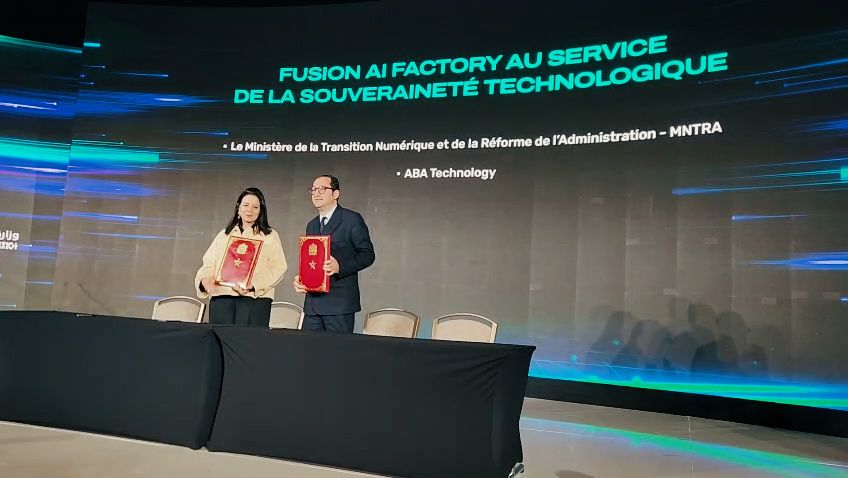
Fusion AI: prefiguring autonomous systems and technological sovereignty
During GITEX Africa 2025, Mohamed Benouda, President of Aba Technology, presented Fusion AI, a platform for interoperability of autonomous intelligent agents, which is part of a national roadmap to strengthen Morocco's technological sovereignty. This plan, structured around talent, local industry, Fab Labs, and startups, aims to make AI a lever for industrial and digital autonomy, a pivot for tomorrow's autonomous systems.
Vision & Positioning
Technological Sovereignty, the Foundation of Integrated Innovation
ABA Technology places industrial, digital, and health sovereignty at the heart of its strategy since its inception. Full control of the hardware cycle (electronic boards, enclosures) to software allows for reduced dependence on imports, strengthened industrial resilience, and the creation of skilled jobs.
By developing vertical solutions tailored to key sectors (health, supply chain, industry 4.0, smart cities), the group aims for local technological autonomy while aligning with the national ambitions promoted by the authorities.
Concrete applications & societal impact
Technologies at the Service of Priority Sectors
Aba Technology articulates its vision around concrete and impactful use cases:
Connected Health (Mediot): IoT medical devices for care closer to needs.
Supply Chain (SCX Technology): IoT solutions for traceability and logistical optimization.
Industry 4.0 (Hardiot + Mana Technology): Automation of manufacturers and process industries (mining, cement, metallurgy, petrochemistry).
Smart Cities (I-city & Nextcor): Integration of intelligent systems for surveillance, access control, and perimeter security.
Fusion AI: Orchestration platform for autonomous agents, essential for smart industry, predictive maintenance, and real-time coordination between physical and software systems.
By targeting these areas, the societal impact manifests in qualified jobs, stimulated innovation ecosystems, and broader technological inclusion.
Sovereignty & responsibility
Building a sustainable and responsible technological autonomy
Aba Technology's strategy fits within a national dynamic supported by the Ministry of Digital Transition. This partnership aims to structure a sustainable technological sovereignty, addressing global challenges of crisis, cybersecurity, and external dependencies.
The 7 pillars of the national program include:
Mass training: aiming for 20,000 people/year on AI, IoT, cybersecurity, and Edge computing.
Reduction of the IT-OT gap: creating an essential hardware-software complementarity for autonomy.
Research: 25% of revenue dedicated to R&D, with a target of 100 researchers by 2030.
Fab Labs & open innovation: regional prototyping networks to accelerate innovation.
Startup ecosystem: support for 35 co-founders by 2030, with participation in capital.
Mobilization of the diaspora: a call to Moroccan talents abroad.
Technological acceleration & open source: dedicated zones and opening Fusion AI to the national ecosystem.
This model links sovereignty to a sociotechnical responsibility, placing people, qualified employment, and ethics at the center of innovation.
Key message: AI is not an end in itself but a lever for technological sovereignty and industrial autonomy, serving humanity and national resilience.